Public Case Study
Posti · OmaPosti Pro
Aligning a live B2B shipping service across brand, workflows, and teams
As Lead Designer for OmaPosti Pro, I connected Posti’s brand migration with merchant research and implementation. The brand-aligned experience, renewed shipment flow, and service home shipped during my engagement.
- Situation
- A live B2B shipping portal needed a new brand, more coherent UX, and a practical migration path for people using legacy systems.
- My role
- Lead Designer for OmaPosti Pro, responsible for product design decisions together with the Product Owner.
- Contribution
- Focus Area
- Portfolio coherence
- Period
- August 2023–February 2024
- Verified change
- The brand-aligned experience, renewed shipment flow, and service home shipped during my engagement.
Early evidence
The renewed shipment flow became part of how the product works
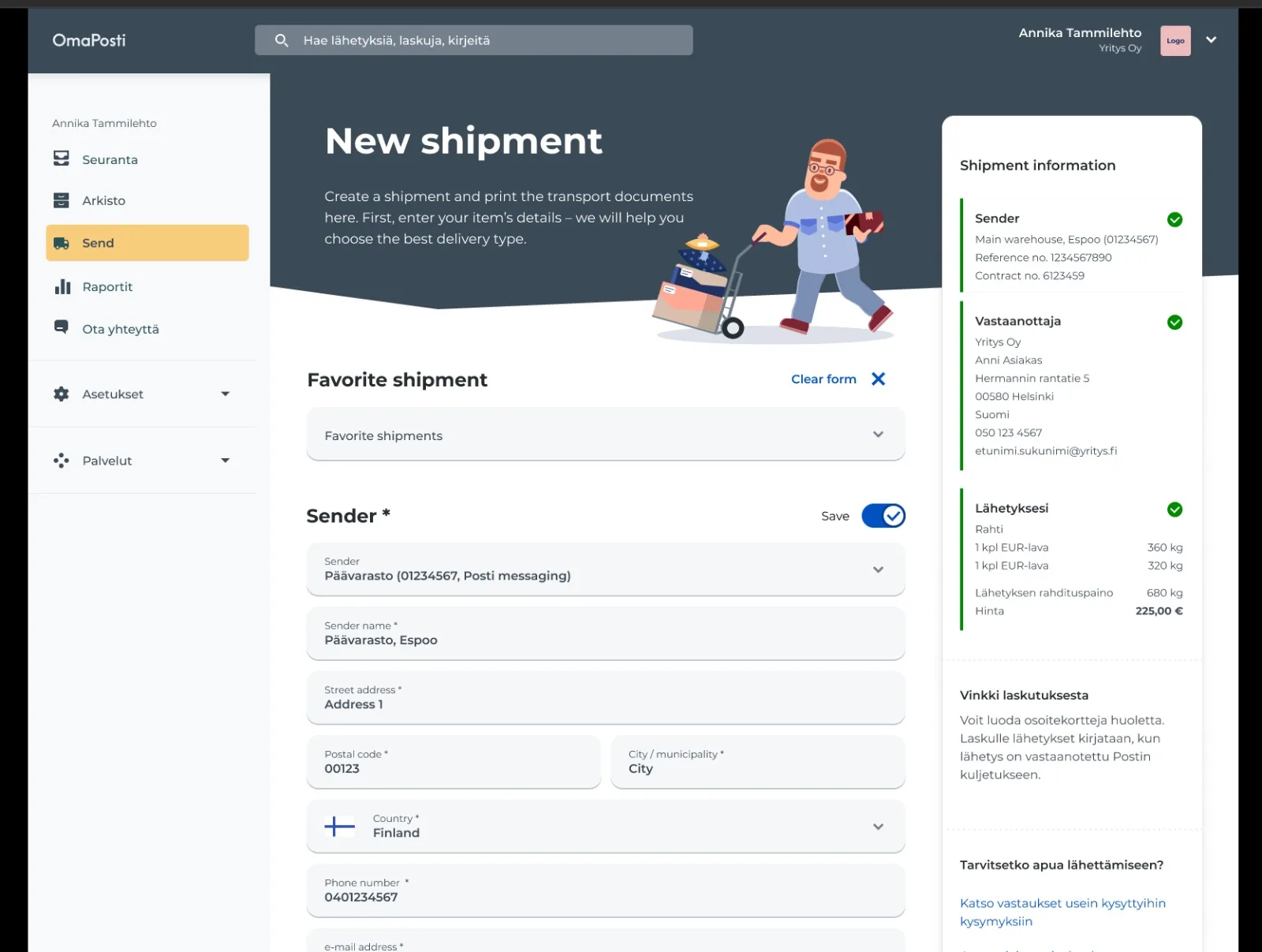
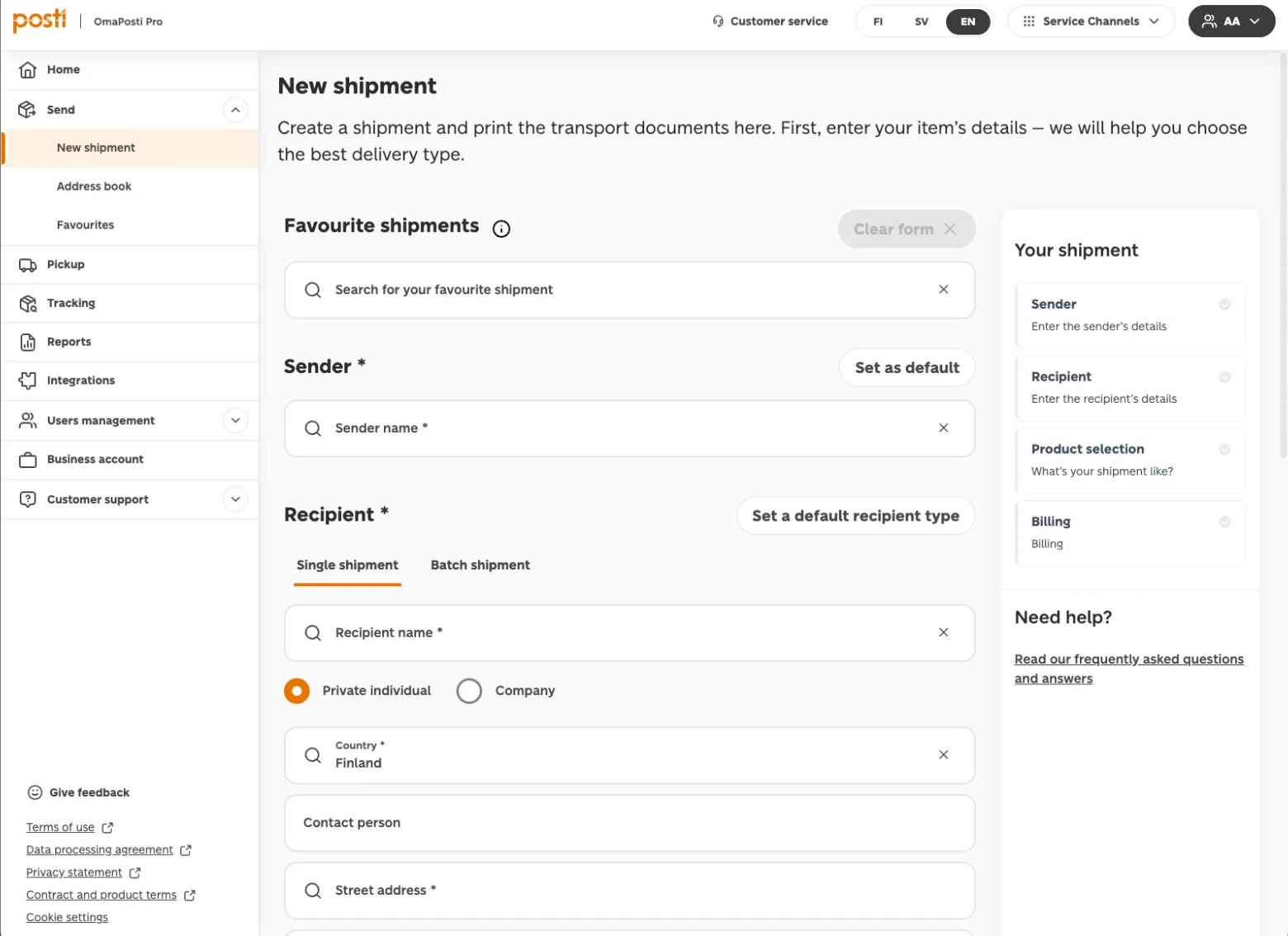
The approved before-and-after screenshots document a production redesign. Useful workflow support was retained while the interface moved from a bespoke legacy expression to Posti’s new brand and a more systematic structure.
Decision atlas
Three decisions turned a brand migration into product work
The redesign had to connect cross-product alignment with daily shipping work. These decisions show how shared direction, research, and implementation constraints came together in the product.
- 01 Make the new brand part of how the product works Multi-team inconsistency → reusable patterns → shipped brand-aligned experience
- 02 Design migration around real shipping needs Merchant research → shipping needs → precise concept boundary
- 03 Give the service a clear home for everyday work Missing orientation → operational overview → shipped service home
Consequential decision
Make the new brand part of how the product works, not a visual reskin
The problem
Different teams had built different parts of OmaPosti Pro in different ways. Navigation, forms, layouts, interactions, and guidance varied. A visual update alone would not address that.
Evidence and reasoning
OmaPosti Pro needed to sit alongside Posti.fi, the consumer OmaPosti service, and the Posti Design System while still supporting B2B logistics work. I worked with lead designers and development teams to establish which patterns could be shared and which needed to remain specific to this product.
Design response
I translated the new brand into clearer navigation, form structure, page hierarchy, reusable components, and shared product patterns. I checked feasibility with developers before refining the UI for implementation.
Proof
The before-and-after comparison above is the approved visual evidence for this decision.
See the full comparison ↑ ShippedConsequential decision
Design migration around real shipping needs
The problem
Some SME e-commerce merchants continued to rely on legacy shipping systems because their daily work depended on capabilities the new service did not yet support.
Evidence and reasoning
In approximately five to eight merchant interviews, batch shipment label printing emerged as a clear need. Merchants handling repeated fulfilment needed a different workflow from those creating occasional single shipments.
Design response
I used this finding to distinguish single-shipment and batch-shipment needs in the renewed flow. I also designed a conceptual card-payment onboarding flow for smaller customers who could not use invoicing.
Proof
The renewed shipment flow makes the difference between single and batch needs clear. It does not show that the full batch workflow was shipped.
Consequential decision
Give the service a clear home for everyday work
The problem
OmaPosti Pro had no clear starting point. New users needed help understanding the service. Returning users needed quick access to shipments, key tasks, guidance, and deviations needing attention.
Evidence and reasoning
Service and workflow mapping showed that separate tools were not enough. In logistics, exceptions can matter as much as normal shipment status, so the service home needed to support both orientation and day-to-day work.
Design response
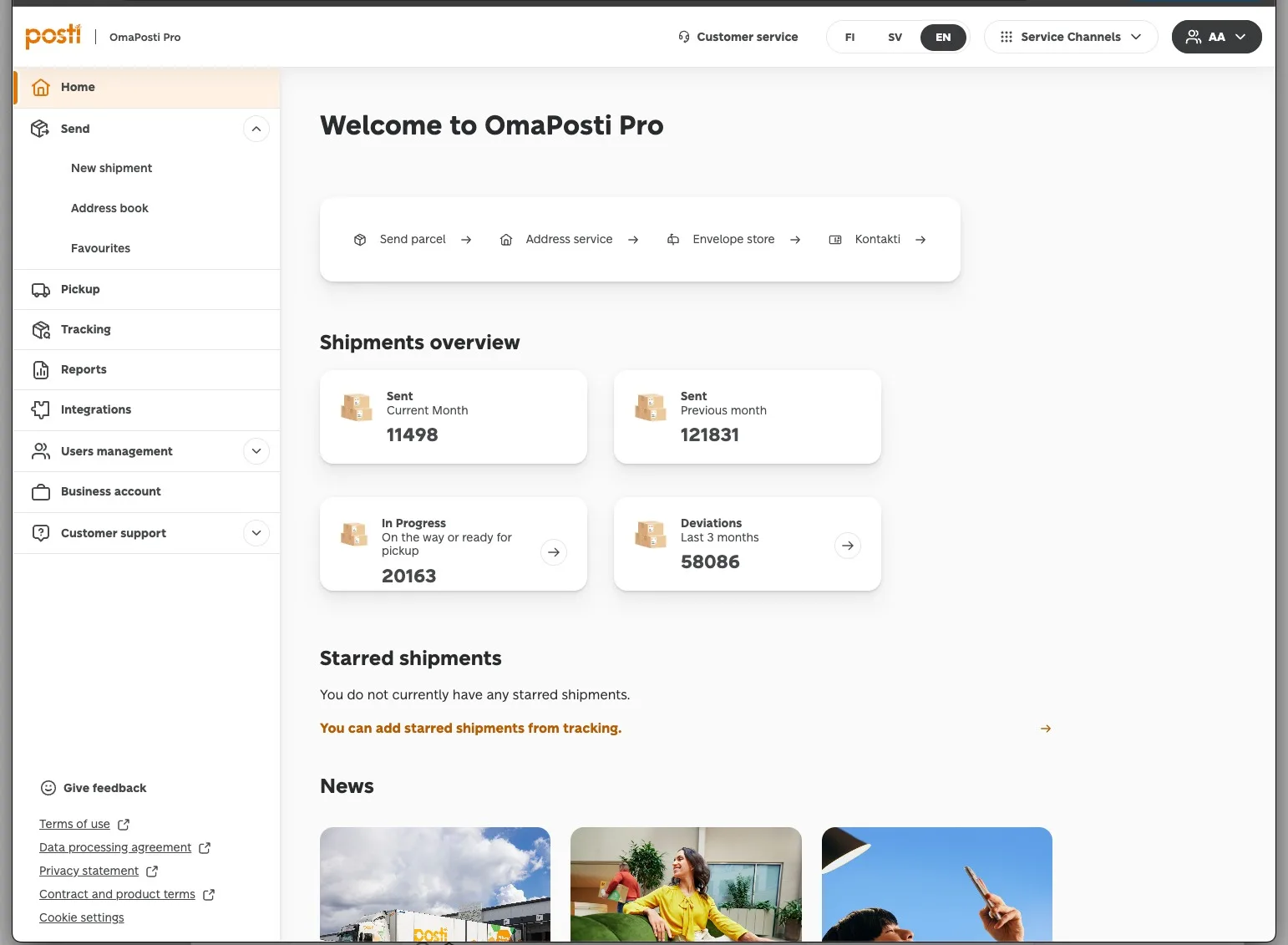
I designed a service home with clear entry points, a shipment overview, deviations, starred shipments, guidance, and product updates. It supports people using the service for the first time as well as those returning to manage daily work.
Proof
The approved screenshot shows the shipped service home with core entry points, shipment summaries, deviations, starred shipments, and news.
Results
What changed
During my engagement, the brand-aligned experience, renewed shipment flow, and service home shipped. I connected shared direction across products with research, detailed UX, and implementation-ready design.
Evidence boundary
What this does not establish
The evidence confirms delivery, not adoption or business impact. Card-payment onboarding remained a concept.
Collaboration and constraints
Leading design in a multi-product, multi-team environment
My responsibility
I led OmaPosti Pro’s design direction with the Product Owner. I conducted merchant research, mapped journeys and flows, designed the renewed shipment flow and service home, aligned patterns, and prepared UX and UI for implementation.
Wider team
I worked with the Product Owner, several development teams, lead designers for OmaPosti and Posti.fi, the Posti Design System lead, and customer-insight specialists. Delivery and the wider brand programme were shared team responsibilities.
Material constraints
The redesign had to be delivered in a live product with distributed ownership and legacy logistics back ends. The UI had to respect operational rules the product could not simplify or guarantee on its own.
Start a conversation
What has become fragmented, difficult to use, or hard to decide?
Tell me briefly about the situation. I’ll reply with an initial perspective and a sensible next step.